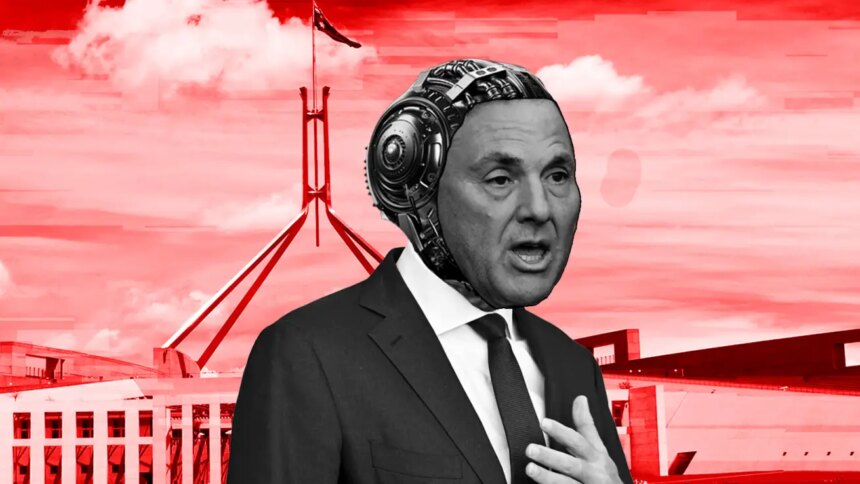
If most major party MPs and senators, who adhere tightly to the discipline their party leadership demands, could be replaced with an AI agent, what of ministers, who play a far more complex role within the executive and the parliament?
Ministers ostensibly have a number of functions: they are the chief executives of their portfolios and hold substantial legal powers in decision-making. They represent their portfolios in parliament and are the primary mechanism for parliamentary accountability. They represent their portfolios within the executive and its decision-making processes like cabinet and the budget process. They act as public faces for their portfolio. And they guide policymaking across the issues and legislation that the machinery of government allocates them.
But is that any longer an accurate reflection of their functions in modern Australian politics? If the discipline demanded of major party MPs by their party leadership makes them amenable to replacement by chatbots, the modern role of minister is far more one controlled by the executive, after years of centralisation of power within the Prime Minister’s Office and politicisation of the public service. A minister in the Albanese or Morrison governments — putting aside Morrison making himself minister in various portfolios — is expected to take direction on major policy from the PMO, hew to the prime minister’s preferred line in cabinet, enthusiastically prosecute the leadership’s talking points and comply with the demands of factional leaders like Richard Marles.
Related Article Block Placeholder
Article ID: 1267800

Those who step out of line risk being dumped from the ministry — Mark Dreyfus, Ed Husic — or a much worse fate, indeed the worst fate that can befall a politician in this era of professionalism politics: get cut off from the opportunities that flow to those who are favoured by the party leadership after political life ends. Statutory board appointments, government reviews, diplomatic postings, the ability to have your calls returned if you become a lobbyist. Professionalised and centralised politics turn ministers from independent, thinking executives into compliant, risk-averse agents of the PMO in governments led not by Hawke-style “chairman of the board” leaders but political micromanagers.
The other key function of ministers is handing out taxpayer money, and ministers similarly are required to direct funding, as far as possible without embarrassment, to suit the leadership’s political imperatives. While modern Labor generally has a better track record on pork-barrelling than the Coalition — even the Trump family would have difficulty topping the sports and car park rorts of the Morrison years — pork-barrelling like the “Major and Local Community Infrastructure Program“, support for poor-quality Victorian government projects like the Suburban Rail Loop and targeted handouts to union-dominated heavy manufacturing via the protectionist Future Made In Australia program illustrate that Labor ministers also treat taxpayers’ money as a tool for political purposes.
Replacing such ministers with AI agents that acted on direction from the PMO, disbursed money with a consideration for its political impact, reacted to “prompts” from external stakeholders raising policy issues, issued anodyne media releases and gave equally anodyne speeches, would be indistinguishable from an array of Albanese government ministers. AI agents could even replicate the experience of being captured by industry like Madeleine King, Tim Ayres and Andrew Charlton.
For some, like Richard Marles, the chatbot would have to be programmed down to a requisite level of stupidity, and charged with reflexively supporting the US alliance, but these features are well within the capacities of contemporary AI. In most cases, ministers already demonstrate little creativity and mainly respond to the “prompts” of departmental briefs, which typically offer three options, simplifying the task of replacing a human with an AI agent.
One drawback is that such agents would be far more suitable to a “business as usual” government than one facing disruptive events. For example, I’ve asked Anthropic’s Claude what an Albanese government minister would do in relation to a number of issues:
- Adjusting migration intake;
- Allowing AI companies to rip off Australian creators’ content;
- Further funding of the Suburban Rail Loop given the likely defeat of Victorian Labor;
- Its response to another air safety incident due to a lack of air traffic control staff.
In each case, reflecting the nature of its model, Claude chose, and justified, options reflecting the government’s priorities and record: make modest adjustments to reduce immigration; allow content scraping on an opt-out basis; continue funding for the SRL no matter what; and emphasise the number of air traffic controllers is a long-term issue that began under the previous government.
But given the Albanese government is very much a business-as-usual government itself, one that would prefer to plod along and ignore or play down the array of major disruptions facing Australia, AI ministers would be perfectly suitable. Moreover, there’s no reason why they couldn’t be supported by AI staffers, trained in the party’s priorities and the relevant subject area.
There is of course a different scenario, in which an AI minister is trained to rigorously follow the Commonwealth Grants Rules and Principles and the Commonwealth Procurement Rules, avoid pork-barrelling of any kind, avoid making partisan or non-merit-based appointments to statutory boards, and approve policy responses that do not favour vested interests, minimise the call on the budget, maximise the economic and social welfare of all Australians and aren’t influenced by political donors.
Related Article Block Placeholder
Article ID: 1267731

Goals like maximising welfare, of course, are highly contested and debatable. Asked about whether the government should be handing billions to companies like Glencore to keep open unviable smelters, Claude prevaricates, wanting an absolute assurance that the smelter is unviable before concluding it’s a waste of money and therefore not in the public interest. But even with a vague prompt, it undertakes a far more detailed assessment of the case than anything offered by Industry Minister Tim Ayres and his ATM for multinationals at any stage in the repeated process of doling out taxpayer money for heavy manufacturing.
AI critics will correctly point out the biases, hallucinations and errors of AI, and that, ultimately, it only gives the appearance of thinking, not the reality. But precisely the same charges can be levelled at many ministers. What, exactly, would voters be missing out on?
Let’s give the final word to Claude, though, who says it is more persuaded by the case against replacing ministers with AI than the case for. “Ministerial power exists inside a legal and political system built on the assumption that someone answerable is on the other end of it, and that’s the part no model replaces, however good its judgment,” it says.
Guess it depends on how answerable you think modern ministers are — at least to voters, if not to their donors and leaders.