President Donald Trump has firmly rejected reports suggesting that the United States will provide financial assistance to Iran under a newly negotiated peace agreement aimed at ending months of conflict and reopening the strategically vital Strait of Hormuz.
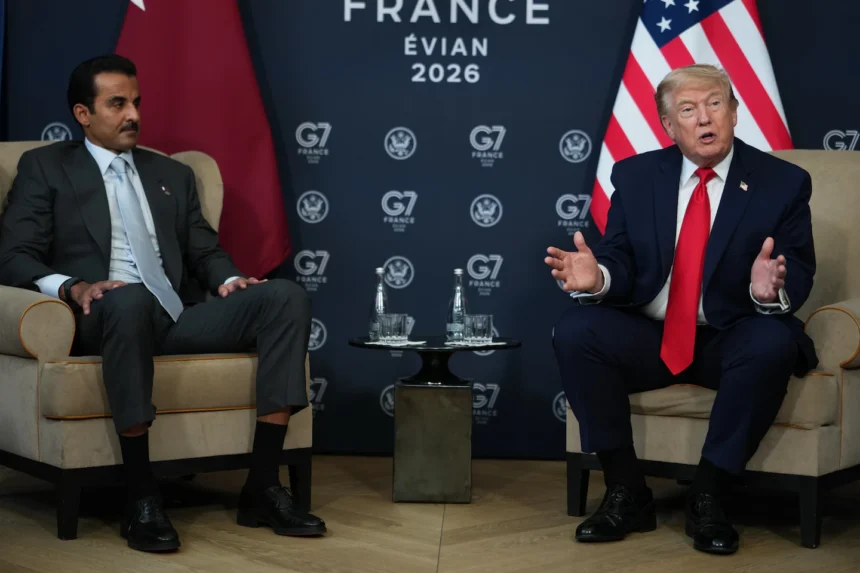
Speaking during the G7 Summit in France, Trump dismissed claims that American taxpayer money would be directed toward Iran, calling such reports “ridiculous” and emphasizing that Washington’s primary objective remains preventing Tehran from acquiring nuclear weapons.
The remarks come as details continue to emerge about a framework agreement between the United States and Iran that could formally be signed in Geneva later this week. While administration officials have celebrated the deal as a major diplomatic breakthrough, questions remain about sanctions relief, frozen Iranian assets, and a reported multibillion-dollar investment mechanism associated with the agreement.
Key Highlights
- Trump says no US taxpayer money will be invested in Iran.
- Reports have circulated regarding a potential $300 billion investment or reconstruction framework.
- Vice President JD Vance suggested Iran could gain access to investment opportunities if it complies with the agreement.
- The deal is expected to reopen the Strait of Hormuz.
- The agreement reportedly includes commitments regarding Iran’s nuclear activities.
- Critics argue important questions remain unanswered.
What Trump Actually Said
During meetings with international leaders at the G7 summit, Trump directly addressed reports claiming Iran would receive major financial support under the peace agreement.
“We are not investing any money in Iran,” Trump told reporters, rejecting suggestions that Washington would fund reconstruction or development projects in the country. He acknowledged that future investment opportunities may eventually emerge but insisted that such possibilities are not part of the current American commitment.
The president stressed that his focus remains on security objectives rather than economic assistance.
According to Trump, the central goal of the agreement is ensuring that Iran never obtains a nuclear weapon.
Where Did the $300 Billion Figure Come From?
Much of the controversy stems from reports discussing a potential $300 billion reconstruction and investment framework connected to the broader peace process.
According to multiple reports, the proposed mechanism would not be financed by direct US government payments. Instead, the concept reportedly involves investment commitments from wealthy Gulf states, including members of the Gulf Cooperation Council (GCC).
The reported fund is intended to encourage long-term economic stabilization if Iran fulfills obligations under the agreement.
However, administration officials have repeatedly emphasized that any economic benefits would be conditional and tied to Iranian compliance.
JD Vance’s Comments Added to the Debate
The discussion intensified after Vice President JD Vance commented on the possibility of investment incentives for Iran.
Vance stated that Iran could potentially gain access to a major investment framework funded by Gulf countries if it honors its commitments under the agreement. At the same time, he stressed that Iran would not receive American taxpayer money and that any benefits would depend on substantial changes in Iranian behavior.
He argued that Iran would first need to:
- Comply with nuclear commitments.
- Reduce destabilizing regional activities.
- Meet verification requirements.
- Demonstrate long-term adherence to the agreement.
What Does the Peace Deal Include?
Although the full text has not yet been publicly released, officials from both countries have outlined several major elements.
Reported provisions include:
Reopening the Strait of Hormuz
One of the most important components involves restoring normal shipping through the Strait of Hormuz, a critical route for global energy supplies.
Ceasefire Extension
The agreement reportedly formalizes a continuation of the ceasefire that has helped reduce fighting in recent weeks.
Future Nuclear Negotiations
The framework appears to establish a process for continued negotiations regarding Iran’s nuclear program rather than resolving every nuclear issue immediately.
Potential Sanctions Relief
Some economic restrictions could eventually be eased if Iran meets specified obligations.
The Nuclear Issue Remains the Biggest Question
Despite optimistic statements from the White House, many analysts note that significant nuclear questions remain unresolved.
Trump has repeatedly argued that the agreement ensures Iran will never possess a nuclear weapon. However, reports indicate that many technical details regarding enrichment, verification, and existing nuclear materials will be addressed in future negotiations rather than the initial framework itself.
This has led some critics to argue that the current agreement represents a starting point rather than a final settlement.
Why the Strait of Hormuz Matters
The reopening of the Strait of Hormuz is one of the agreement’s most economically significant outcomes.
Before the conflict, roughly one-fifth of the world’s energy supplies moved through the waterway. Disruptions during the war contributed to higher oil prices, increased shipping costs, and uncertainty in global markets.
Officials hope that restoring maritime traffic will:
- Stabilize energy markets.
- Reduce shipping risks.
- Lower transportation costs.
- Ease inflation pressures globally.
Oil prices have already reacted positively to news of the deal.
Why Critics Remain Skeptical
Not everyone is convinced the agreement resolves the underlying issues that led to the conflict.
Critics argue that:
- Key nuclear questions remain unanswered.
- Enforcement mechanisms are unclear.
- Regional tensions could quickly return.
- Iran and the United States have presented different interpretations of the agreement.
Some Israeli officials and members of Congress have also expressed concerns about whether the framework adequately addresses long-term security risks.
Timeline of Events
February 2026
The Iran conflict escalates into a major regional crisis.
March–May 2026
Fighting intensifies while diplomatic efforts continue behind the scenes.
June 7, 2026
Trump indicates sanctions relief and access to frozen assets could be considered if Iran complies with future agreements.
June 14–15, 2026
US and Iranian officials announce a preliminary framework to end fighting and reopen the Strait of Hormuz.
June 16, 2026
Trump publicly rejects reports that the United States will invest money in Iran.
Expected June 20, 2026
Formal signing ceremonies are expected in Geneva.
Why This Story Matters
The debate surrounding funding for Iran highlights a broader challenge facing the peace process.
For any agreement to succeed, negotiators must balance:
- Security concerns.
- Economic incentives.
- Regional stability.
- Domestic political pressures.
Trump’s comments appear designed to reassure critics who fear that American taxpayers could end up financing Iran’s recovery while still preserving the administration’s ability to pursue diplomacy.
Expert Analysis: Economics May Determine Whether the Deal Survives
While public attention has focused heavily on nuclear issues and military matters, economic incentives may ultimately determine whether a lasting agreement is possible.
Iran seeks sanctions relief, access to frozen assets, and opportunities for economic recovery after years of isolation and conflict. Meanwhile, the United States wants verifiable guarantees regarding nuclear activities and regional security.
Trump’s refusal to commit US funds reflects political realities in Washington, where many lawmakers oppose direct financial support for Tehran. At the same time, investment opportunities backed by Gulf states could provide a compromise that allows economic benefits without requiring direct American spending.
Whether that balance can be maintained will likely determine the success or failure of the broader peace process.
Frequently Asked Questions
Is the United States giving money to Iran?
Trump says no US taxpayer money will be invested in Iran under the agreement.
What is the $300 billion fund?
Reports describe a potential investment framework involving Gulf state funding and private investment opportunities rather than direct US government payments.
Has the peace deal been finalized?
A framework agreement exists, but additional negotiations and a formal signing process are still expected.
What does Trump say is the most important part of the deal?
Trump says preventing Iran from obtaining a nuclear weapon remains his top priority.
Why is the Strait of Hormuz important?
It is one of the world’s most important energy shipping routes and a key factor in global oil markets.
Conclusion
President Donald Trump has moved forcefully to counter reports that the United States will finance Iran as part of a new peace agreement, insisting that no American money is being invested in Tehran. While questions remain about sanctions relief, frozen assets, and a reported multibillion-dollar investment framework, the administration continues to portray the agreement as a major diplomatic achievement focused on preventing nuclear proliferation and restoring stability to global energy markets.
As negotiators prepare for the formal signing of the agreement, the debate over economic incentives may become one of the most closely watched aspects of the entire peace process.
Sources
- The Washington Post
- Reuters
- White House statements
- G7 Summit briefings
- Comments by Vice President JD Vance
- International energy and diplomatic reporting