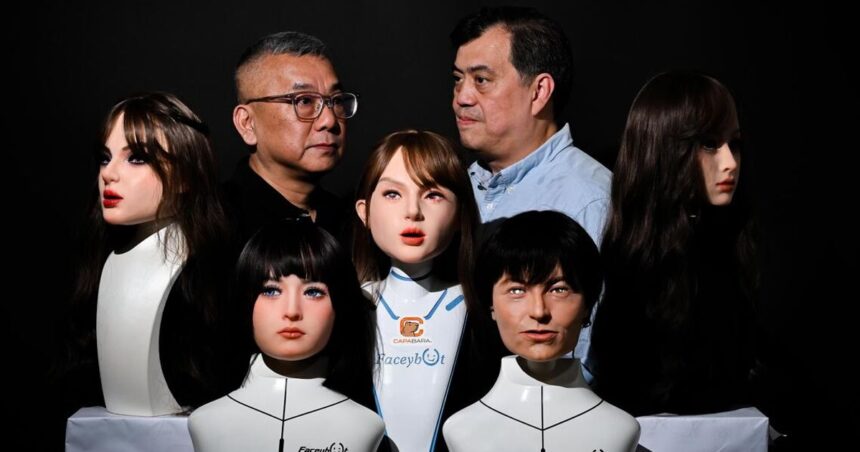
SINGAPORE – Practising tough conversations usually requires hiring human actors, who can get tired, go off-script or break character. Relying on them can also get expensive over time.
In the first quarter of 2027, eldercare and customer service trainees in Singapore will be able to practice on an opponent that never tires or breaks character. What’s more, these rehearsals can be repeated as often as needed without racking up actor fees, which start at $500 for a full day per actor.
This lifelike robot called FaceyBot is being brought to Singapore by local training consultancy Straits Interactive in partnership with Chinese manufacturer Shenzhen Xiaoquan Technology Culture.
Powered by tiny motors beneath a medical-grade silicone face, FaceyBot consists of a head and an armless torso. It is unlike many existing training robots, which have rigid plastic faces.
For now, Faceybot can manage more than a dozen major expressions, including worry, anger and surprise, as well as hundreds of subtler ones such as a faint smile or a raised eyebrow, said Wang Quan Sheng, chief executive of Shenzhen Xiaoquan Technology Culture.
Shenzhen Xiaoquan’s technology has been exhibited in China, but commercially rolled out.
Other competitors in the space include Shenzhen-based robotics company UBTech, whose full-sized humanoid robots include eye cameras, chest sensors and listening microphones. Another firm Shanghai-headquartered AheadForm’s expressive humanoid robot performed a song at a robot gala in February 2026.
Straits Interactive chose to work with Shenzhen Xiaoquan because its technology stood out for its realistic facial movements, and had won a robotics innovation award at an AI trade show in Shenzhen in August.
Straits Interactive’s robots are priced from $10,000, includes AI application customisation and systems integration. Its Capabara software uses AI models to play the role of an irate customer or a confused patient.
Guardrails to be built into training scenarios. These include limiting the databases accessed and the information collected, and logging every interaction for review.
Kevin Shepherdson, founder of Straits Interactive, said human actors can tire or break character, varying the role-playing experience, whereas a robot behaves consistently.
Arguing for a 3D humanoid over a virtual agent, he said: “A physical face creates real emotional pressure that a monitor cannot replicate. Physical presence also trains someone’s body language, not just words to say.”
One potential customer Sharon Tong, who runs media training firm The Media Consultants, is exploring how FaceyBot could help executives prepare for panel discussions.
Currently, the executive’s colleagues would be roped in to stand in as other panelists. But they may lack the expertise and knowledge of senior corporate executives to tackle complex global and technical issues, leaving little room for the senior executive in training to spar, said Tong.
Faceybot robots can also be programmed to be long-winded or skeptical panellists, so senior executives can learn to respond, Tong added.
Prof Jochen Wirtz, vice-dean of MBA programmes at the National University of Singapore Business School, said: “Highly-realistic facial expressions add value when trainees practise recognising distress, confusion, dementia behaviours, fear, pain or disengagement.”
Prof Zheng Yuanjin, from School of Electrical and Electronic Engineering at Nanyang Technological University, said the first uses could be in supervised caregiver and nursing training. For instance, trainees may need repeated exposure to non-verbal cues such as a grimace to signal pain.
But the robots have to stand up to routine cleaning and deliver expressions and speech reliably across local languages and accents, Zheng said.
When demonstrated on Nov 13 at Straits Interactive’s office, the robot had lips that fell out of step with its words. These flaws are being fixed, and the firm is in the midst of securing partners to pilot the technology.
When rolled out in 2027, FaceyBot will be able to understand and speak English and Mandarin for a start.
“Psychologically, we are wired to read faces,” said Shepherdson.
“When a lifelike face turns towards us and responds with expression, our defences drop and trust builds quickly. That is what makes the robot such a persuasive and effective tool, and also why it should only be used in specific scenarios.”