SINGAPORE – For 1½ years, the hundreds of turtles and tortoises from Connie Tan’s museum were “nomads” in search of a permanent home.
On Nov 20, the animals’ peripatetic life officially ended when the Live Turtle Museum Singapore formally reopened at 11 Chencharu Close in Khatib.
This is the museum’s fourth home since it started in Neil Road in 2001.
The relocation to Khatib cost $2 million, Tan said.
There are other costs incurred by the relocation, she added. As turtles and tortoises are sensitive to disrupted and temporary holding spaces, the moves over the years have affected their survival.
The museum now has over 600 of the animals, compared with more than 1,000 when it was located at Chinese Garden from 2002 to 2018.
Tan noted that constantly moving and placing them in interim spaces makes them uncomfortable and causes their numbers to drop.
“I cry each time the turtles pass on,” she said.
Before going to Chencharu Close, the museum was at ORTO in Yishun from 2019 until February 2025, when it had to move out as the authorities are redeveloping the land.

To mark the official reopening of the Live Turtle Museum Singapore, a long string of kangkong was cut by (from left) museum founder Connie Tan, former Member of Parliament Teo Ho Pin, Senior Parliamentary Secretary for Education and National Development Syed Harun Alhabsyi, and museum director Jedd Joseph.
ST PHOTO: GAVIN FOO
At around 1,200 sq m, the Chencharu Close plot is one of the museum’s larger sites.
The turtles and tortoises cannot rest easy just yet, though.
Their Chencharu Close home is under a three-plus-three-plus-three-year lease, with the first three-year term ending in September 2027.
After Tan signed the lease, the construction ran into difficulties, causing the opening of the museum to be delayed.
She is glad the museum, which used to be called Live Turtle and Tortoise Museum, is open to visitors again.
“When people meet turtles personally, not through screens or books, what I see time and again is that they become more connected, more caring, and truly committed to conservation,” Tan said.
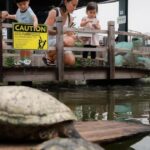
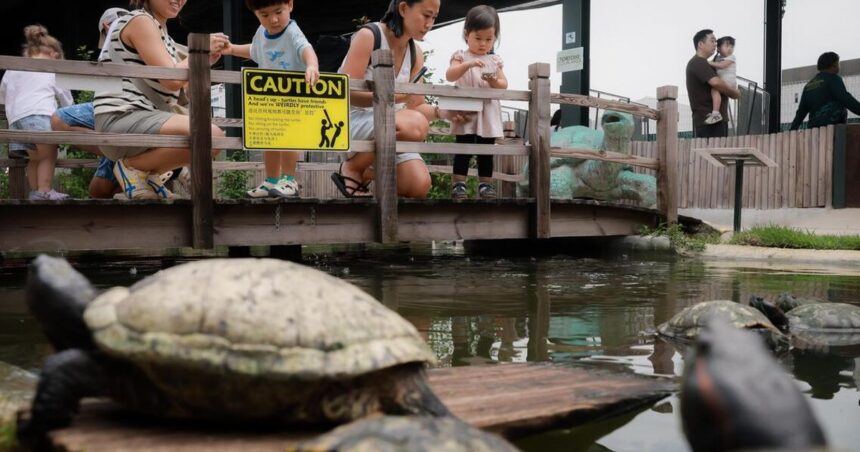
Visitors entering the sanctuary can tour indoor and outdoor habitats featuring species such as the Aldabra Giant Tortoise, Alligator Snapping Turtle, Pig-Nosed Flying Turtle, Malaysian Giant River Turtle, and Radiated Tortoise.
They can also join supervised feeding sessions.
Tan’s fascination with turtles began when she was around six years old, keeping one secretly under her bed because her mother would not allow pets at home.

A pig-nosed turtle at the Live Turtle Museum Singapore.
ST PHOTO: GAVIN FOO
She started collecting them when they were widely sold in Singapore before stricter wildlife rules took effect in 1986, eventually growing a personal collection that she cared for along with her son and father.
Her ultimate goal for the museum is that visitors’ close-up encounters will foster respect for all turtles and stop people from treating them as disposable pets.
The museum also collaborates with researchers and hosts tours for pre-schoolers to develop its educational role.
Currently, a team from Nanyang Technological University are researching the organisational history and anthropology of turtles, Tan said.

More than 3,000 turtle and tortoise artefacts from around the world are on display at Live Turtle Museum Singapore’s new premises.
ST PHOTO: GAVIN FOO
Speaking at the museum’s opening ceremony, Teo Ho Pin, former mayor of North West CDC, said: “The true success of a conservation institution should not be measured simply by the number of animals it houses or visitors it attracts, but by the positive difference it makes to the survival and welfare of species and the attitudes of people.
“A child who learns to care for a turtle today may grow up to become an adult who cares deeply about protecting our environment tomorrow.”

Former MP Teo Ho Pin (left), Senior Parliamentary Secretary for Education and National Development Syed Harun Alhabsyi (2nd from right), museum founder Connie Tan (right) and museum director Jedd Joseph (2nd from left) feed Xiao Hei, an Aldabra giant tortoise, at Live Turtle Museum Singapore.
ST PHOTO: GAVIN FOO