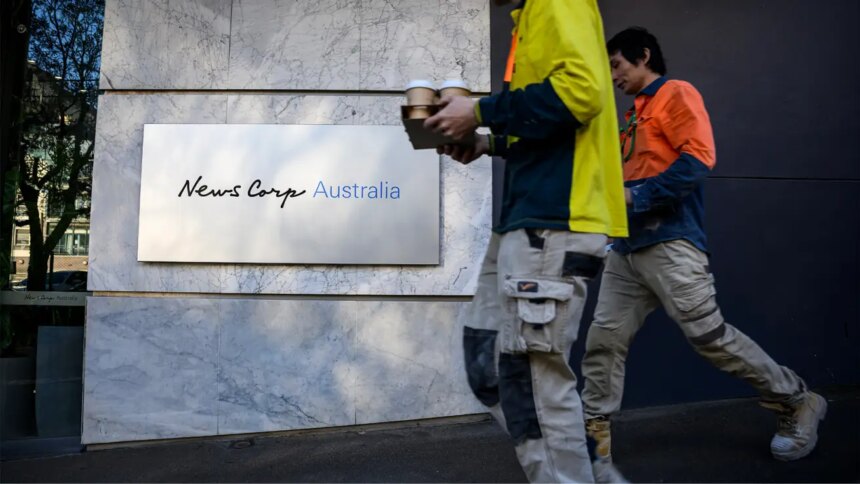
It’s unsurprising a foreign corporation operating on a business model of fostering social division in our country should endorse wage theft by Australian businesses. What better way to encourage the sense that the system is rigged against ordinary folk? Presumably that’s the reason why News Corp, via its Sydney rag Daily Telegraph, this week took aim at the Australian Taxation Office (ATO) for sending letters to small businesses that may have unpaid superannuation obligations, declaring it “the new robodebt”.
News Corp doesn’t like the ATO, of course. It was the tax office that, in 2015, identified the US company as the nation’s number one tax risk. The ATO’s description has been well borne out since then, as News Corp hasn’t paid a single cent in tax in the ensuing decade, despite earning nearly $24 billion in revenue and $1.38 billion in profits. Every year, via the annual corporate tax transparency report, the ATO demonstrates how utterly hollow and hypocritical News Corp’s pretence of being a contributor to Australian civic life is.
But the ATO letters to small business aren’t about taxes owed to the government by small business. They’re about superannuation contributions, which belong to workers. Indeed, they’re part of workers’ wages. Businesses failing to pay superannuation contributions are stealing wages from their workers.
Related Article Block Placeholder
Article ID: 1267229

There’s an awful lot of wage theft going on in that area. According to the ATO, every year around $7 billion out of $120 billion in super contributions isn’t paid. It’s the tax office’s role to, in the words of the auditor-general, “encourage voluntary compliance and enforce the penalties of non‐compliance” in the superannuation guarantee system. The auditor-general in 2022 examined the ATO’s performance in that regard and criticised it, describing its compliance activities as only “partly effective”, although the picture was muddied by the fact that the ATO had suspended a lot of compliance activities during the pandemic.
Part of the ATO’s toolkit for improving compliance is nudge letters to businesses that may have unpaid obligations, before escalating to more formal compliance actions. Without any further enforcement action, small businesses receiving letters from the ATO paid up an additional $467 million in super contributions for the 2025-26 financial year.
The auditor-general was right to target the ATO’s performance. Every dollar unpaid to a worker’s super fund isn’t just ordinary wage theft, it’s theft on steroids: that dollar would, over the worker’s career, earn substantial additional income for retirement via the super system. Each dollar stolen is a slap in the face for workers now, and a bigger one when they retire.
So, where are we? The auditor-general says the ATO needs to lift its game on getting workers’ super contributions paid. The ATO secures nearly half a billion in payments just by sending out some form letters to small businesses that, undoubtedly in many cases, have been too busy to get their accounts in order, or need to improve their payroll system.
But for News Corp — and, evidently, shadow treasurer Tim Wilson, whose office seems to have been deeply involved in prepping News Corp for the story — that’s, somehow, the “new robodebt”.
Let’s pause it there for a moment: the Telegraph using robodebt as a negative? This is a paper that ran a series of false articles about what it called “an army of bludgers” about disability support pension recipients in 2014. In 2016, it ran articles (now offline) demonising young jobless people, complete with quotes from then-treasurer and architect of robodebt, Scott Morrison. News Corp is a serial offender when it comes to bashing welfare recipients, and was instrumental in creating the political atmosphere that encouraged Morrison to take an unlawful debt recovery scheme to cabinet. It doesn’t get to talk about robodebt as if it were somehow neutral in that stain on Australian public life.
Never forget, robodebt cost people their lives. To now compare it to form letters from the ATO is appalling, particularly from a serial basher of welfare recipients. Not that the Telegraph is alone in misusing robodebt. It was another foreign media company, The Guardian, that first started that fashion, entirely confecting an outrage it dubbed “robotax” in 2024 — a beat-up made all the more ironic given The Guardian has been accused of dodging tax itself.
Comparing the nudge letters to robodebt is particularly absurd because, as the ATO pointed out, the letters have no formal status. They don’t create a debt, or demand payment, or provide an assessment; they merely identify that there may be a discrepancy and ask the business to check. But the ATO gets belted by the auditor-general if it isn’t proactive enough on super obligations, and then belted by a tax-dodging foreign company — and the lightweight man-child occupying the shadow treasurer role — if it is proactive.
Where was Jim Chalmers in all this? On Tuesday, the treasurer declared he’d told the ATO to change its approach. “We’ve spoken to the ATO about improving those processes. We think that that’s important that those processes be improved. As I understand it, the ATO has now paused those letters while they improve those processes.”
Related Article Block Placeholder
Article ID: 1271154
It’s yet another backdown from a government increasingly characterised by backdowns, backflips and somersaults on policy issues major and minor when pressured by the media, vested interests, the opposition or One Nation. Politics is the art of the possible, and you have to know how to compromise to be effective, but this is a government that has always jumped at shadows, and is doing it more and more — an instinct that should be sheeted home to its unambitious, managerialist dud of a prime minister, not its treasurer. It also comes after the last backdown, in October, around the ATO: pausing the end of credit card tax payments.
This absurd pandering to small business marks the whole political class in Australia. It’s also unsurprising that small businesses are particularly remiss when it comes to superannuation payments — small business lobby groups have long pushed for the responsibility for administering super payments to be taken away from them — and also disproportionately likely to fail to pay taxes. In a remarkable recent submission to an inquiry into small business tax debt, the ATO noted that of the $126 billion it was owed in tax debt at the end of June, around half of that was what it regarded as “collectable debt”. Small business is responsible for over $40 billion of that, or nearly two-thirds. That’s in contrast to the small business’ share of the total tax take, which is 14%.
As the ATO noted, most small businesses try to do the right thing and meet their tax obligations. Doubtless the same could be said about super obligations. But there’s a large chunk of tax dodgers in small business as well: “disengaged” taxpayers who owe billions of dollars. The reflexive genuflecting at the altar of small business by the political class does nothing to help tax revenue at a time when the federal budget isn’t exactly in a healthy state. And it won’t help workers and their retirement savings.