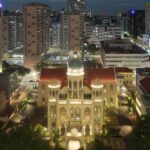
SINGAPORE – Soon after completing an extensive restoration project that cost about $25 million, St Joseph’s Church, a national monument in Victoria Street, had to raise funds for another multimillion-dollar expense – lease renewal.
The Roman Catholic church, which in 2022 reopened after a five-year-long restoration, was at the tail end of a 99-year lease that was due to expire in February 2028.
Earlier in 2026, its lease was renewed for 60 years, which is twice the typical tenure offered to religious organisations undergoing lease renewal.
The longer lease was made possible by a recent policy tweak by the authorities for places of worship that have been gazetted as monuments.
“The longer tenure supports these non-profit institutions in carrying out their religious and community missions, and provides greater certainty for long-term investments to upkeep and restore their historically significant buildings in accordance with preservation requirements,” said the Singapore Land Authority (SLA) and the National Heritage Board (NHB) in a statement to The Straits Times.
The agencies added that lease renewals “are assessed on a case-by-case basis, taking into account the relevant planning, land use and heritage considerations”.
At least two other places of worship that are monuments have been offered 60-year leases – St George’s Church in Minden Road and Tan Si Chong Su, an ancestral hall and Chinese temple in Magazine Road.

Tan Si Chong Su, an ancestral hall and Chinese temple in Magazine Road.
PHOTO: ST FILE
Lease renewal premiums are based on factors such as location, land area, gross floor area, allowable use and lease tenure.
Asked about the 60-year offers, SLA and NHB said the Government regularly reviews its policies to meet Singapore’s evolving needs while safeguarding its built heritage.
“In land-scarce Singapore, the Government generally grants lease renewals for places of worship for up to 30 years, subject to agencies’ assessment, so that land can continue to be planned and allocated to meet changing socio-economic needs over time,” said the two agencies.
In the case of places of worship that are also national monuments, the Government recognises that they typically incur higher costs to maintain and restore their buildings in accordance with preservation requirements, and hold significant heritage value.
Lease renewals of up to 60 years for such places provide “long-term certainty for these places of worship while balancing the need to retain planning flexibility”, SLA and NHB said.
St Joseph’s Church’s 60-year lease took effect on July 15 and cost more than $5 million, said the Archdiocesan Land and Properties Singapore (ALPS), an office which advises the Archbishop of Singapore William Goh on land and property matters.

The ALPS said monument owners are obliged to maintain and safeguard their buildings for the wider public good, and a longer lease gives owners greater security of tenure, as well as to make substantial investments in upkeep and conservation works.
It added that works required on monuments tend to go beyond what normal buildings require as the historical buildings have to follow preservation guidelines issued by the NHB that may require “compatible materials, appropriate traditional techniques, and specialist craftsmen”.
Additional costs are also required for specialist conservation advice, as well as documentation and approval.
Father Joe Lopez, rector of St Joseph’s Church, said Singapore does not have experts to restore some of the church’s artefacts, so the church – which was completed in 1912 – had to hire Portuguese art restorer Filipa Machado to work on its latest round of restoration.
Other places of worship
Singapore has 77 national monuments – sites or buildings given the highest level of protection under local laws – and 30 of them are places of worship.
The figure excludes the Hakka clan association Ying Fo Fui Kun, which has an altar on its premises but is listed on the NHB’s heritage resource portal Roots.gov.sg as a culture and community institution.
Of the 30, 13 are on freehold land, while 11 are on 999-year leases which expire in the year 2826 and beyond, and the Armenian Apostolic Church of St Gregory the Illuminator is on a 99-year lease that ends in 2092.
The remaining five are St Joseph’s Church, St George’s Church, Tan Si Chong Su, Hajjah Fatimah Mosque and Prinsep Street Presbyterian Church.
Hajjah Fatimah Mosque comes under the management of the Islamic Religious Council of Singapore (MUIS), which did not state the mosque’s lease or tenancy status when asked.
A council spokesman said MUIS “remains committed to working with the relevant government agencies to preserve Hajjah Fatimah Mosque’s heritage while ensuring that it continues to serve the religious needs of the community”.
Land for mosques is directly granted to MUIS – which centrally coordinates mosque development – at market price as determined by the chief valuer.

Hajjah Fatimah Mosque comes under the management of MUIS, which did not state the mosque’s lease or tenancy status when asked.
PHOTO: ST FILE
Among the other mosques that are monuments, Alkaff Upper Serangoon and Abdul Gafoor are on freehold land, while Sultan, Jamae and Al-Abrar are on 999-year leases.
Prinsep Street Presbyterian Church had in October 2023 renewed its lease for 30 years at about $1,194 per sq m per plot ratio.
A spokesman for the church’s lease renewal committee told The Straits Times then that the church had hoped for the option of a longer lease, which the committee felt was befitting of the church’s monument status.
ST has contacted the church for comment on the latest policy changes.
Offered 60-year leases
St George’s Church was informed in July 2025 that a 60-year lease renewal was a possibility, said its vicar, Reverend Jonathan Wong.
The monument, which was completed in 1913, is on a three-year temporary occupation licence (TOL), which costs about $300,000 per year and runs until 2029.
Wong, who took over as the Anglican church’s vicar in 2024, said there were previous attempts to secure a longer lease, but raising money for it was challenging, as the church’s congregation was largely transient.
In the early 2000s, up to 90% of its congregation were expatriates; since then, Wong said, there has been a more balanced mix between locals and foreigners.

Policy changes in 2023 allowed St George’s Church to consider a longer-term lease.
PHOTO: ST FILE
Policy changes for land allocation to places of worship in 2023 lowered lease renewal prices.
Under the changes, new land for religious use was allocated based on a fixed-price ballot rather than a competitive tender, bringing down premiums for fresh leases and renewals.
Previously, the renewal premiums factored in recent winning bids from open tenders.
These changes allowed St George’s Church to consider a longer-term lease, Wong added.
In late 2023, the Government said that as at Oct 30 that year, seven religious organisations had renewed their land leases since revised policies took effect, and were paying on average around 47% less than the rates for new places of worship sites in recent tenders before the implementation of the revised framework.
St George’s Church is currently negotiating a 60-year lease with public agencies, and does not yet know its premium.

Wong added that the church expects that a 60-year lease will be cheaper than the price of multiple TOLs over the same period, and that a longer tenure will give the church confidence to invest in building maintenance and possibly new construction.
Wong said the church’s recent TOLs illustrate the financial uncertainty that religious institutions on short-term tenancies face.
Before its current TOL, he said, the church had been on a three-year TOL, which was followed by a two-year extension with a sharp hike on the annual premiums paid during the initial three-year period.
“The sooner we have the price of the land, the sooner we will know how much more we need to raise (for the 60-year lease),” said Wong.
“Right now everyone is in the dark, and it’s difficult to talk to congregants about raising funds when I have no clear target. People want clarity before they give because they are not giving small sums.”
Andrew Tan, chairman of Tan Si Chong Su – or Ancestral Hall of the Tan Clan – said the clan is also negotiating a 60-year lease with the authorities.

Andrew Tan, chairman of Tan Si Chong Su – or Ancestral Hall of the Tan Clan – said the clan is negotiating a 60-year lease with the authorities.
PHOTO: ST FILE
The ancestral hall is housed in a temple that is also known as Po Chiak Keng, which Tan said has been on a yearly TOL since its last 99-year lease expired in the mid-1970s.
Tan said the premium of the 60-year offer is confidential, and added that longer-term cost savings from a longer lease will support the day-to-day operations of the temple, as well as major refurbishment works from time to time.
For instance, the temple is currently undergoing a round of refurbishment works that cost over $1 million, and includes replacing some timber pillars, termite extermination, painting, and roof tiling.

Referring to the ancestral hall’s leadership, he said: “We are all just volunteers not receiving any pay or profiting from temple operations, so we are reliant on donations to keep the temple running.
“The cheaper the land is, the easier it is for the people managing it.”