How do you know the person calling you is really the police?
Johnson, 67, had to work that out in April 2026 when a man claiming to be a Singapore Police Force (SPF) officer rang his landline. The senior operations supervisor declined to share his last name for privacy reasons.
The caller said Johnson’s bank account details surfaced in an overseas money laundering investigation.
Johnson’s first thought was his trips to India and Malaysia in the second half of 2025. Had his details been compromised there?
Then something clicked. Friends had warned him about scam calls like this. The caller’s accent also sounded foreign, the Singaporean says.
He hung up. “If it really was the police, they would reach me (through) other ways,” says Johnson, who mainly uses his mobile phone.
Still, doubts lingered. “I kept thinking about whether I was really in trouble.”
Single dedicated number
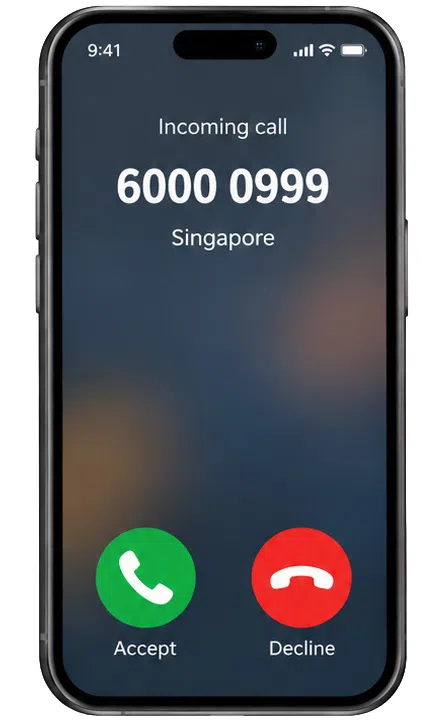
PHOTO: THE SINGAPORE POLICE FORCE
From Nov 2, 2026, official outgoing calls from SPF to members of the public come from 6000 0999, says Superintendent Tay Yuanqi, assistant director of SPF’s Scam Public Education Office, Cyber Command.
This aims to help people tell real officials from impersonators, he adds.
Each call – even if unanswered – will be followed by an SMS from the “gov.sg” sender ID. (See below).

PHOTO: THE SINGAPORE POLICE FORCE
The SMS explains how to contact SPF and usually includes the officer’s name and a contact number for callbacks. It begins with the agency’s full name and ends with a note that it is an automated message from the Government.
The number is strictly for outgoing calls, and will not be used on messaging platforms like WhatsApp or Telegram, Tay says.
SPF is the first government agency to place calls to the public through a single dedicated number. Other agencies are expected to follow progressively, says Tay.
Single Caller ID is a joint initiative by the SPF, the Ministry of Digital Development and Information, the Government Technology Agency of Singapore’s Open Government Products unit, and the Infocomm Media Development Authority.
It builds on the 2024 roll-out of the “gov.sg” SMS sender ID and the 24/7 ScamShield helpline (1799).
From January to September 2026, there were at least 3,230 reported scam cases involving the impersonation of Singapore government officials, with losses amounting to at least $142.5 million, according to SPF data.
The police were the most commonly impersonated, accounting for at least 1,310 cases and $53.3 million in losses.
Measures are in place to curb the number from being spoofed, where scammers disguise calls or messages with a fake caller ID, says Tay.
These build on existing telecommunications safeguards, which include:
-
Blocking overseas calls mimicking the police’s number, like +65 6000 0999; and
-
Measures to prevent the unauthorised use of 6000 0999 and the “gov.sg” sender ID on messaging platforms like WhatsApp and Telegram.
Phoney officials
But these safeguards cannot eliminate government official impersonation scam risks entirely. Tay warns that scammers may still pose as the police in other ways, like calling through messaging apps.
He says scammers have used different approaches to build credibility and pressure victims, such as:
-
Posing as staff from known companies or financial institutions, and claiming that there was an unauthorised transaction or misuse of the victim’s personal data. The victim would be “transferred” to a second call with someone posing as a government official. This makes it seem like a coordinated process escalated to the authorities.
-
Using official titles, actual officials’ personal details, or fake arrest warrants or uniforms. This exploits people’s tendency to trust and obey those they see as authority figures.
-
Accusing victims of serious offences like money laundering and threatening them with arrest, or presenting monetary demands as necessary steps to avoid legal consequences. The resulting fear and urgency can make it harder for victims to pause, question the caller and verify the claims. They may then focus on making the threat go away by following orders.
-
Claiming the investigation is confidential and directing victims not to tell anyone. This prevents them from checking with family members, banks or the authorities, who might challenge the scammer’s claims.
Besides bank transfers, victims may be told to convert their money into cryptocurrency, or hand over cash, gold bars and other valuables for “investigations”.
Tay urges the public to end the call if they are unsure and independently check suspicious communications through official channels.
That is what Johnson did. Hanging up gave him time to think.
“Now, if someone calls me and tells me they are from the SPF but does not have that single caller ID, I will hang up and feel at peace,” he says.

This is part of a series titled “Act against scams”, in partnership with the Singapore Police Force and the National Crime Prevention Council.