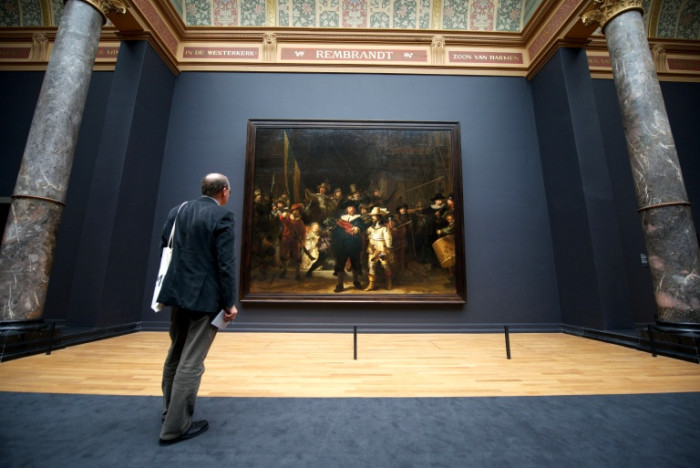
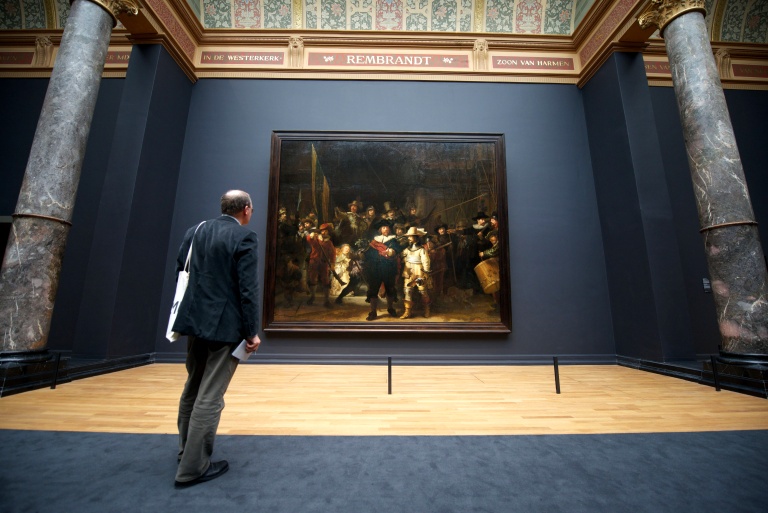
AMSTERDAM (NETHERLANDS) – For years, millions of people have marvelled at Rembrandt’s use of light and shadows to depict the militia in his masterpiece, the “Night Watch”.
Little did they know they were also looking at a hidden world of characters, some of them from as far away as Japan.
A new exhibition, “The Night Watch Lives,” lifts the veil on this clandestine universe: the microbes covering one of the most famous works of the Dutch Golden Age paintings.
A joint effort by Rijksmuseum, where “The Night Watch” hangs and Amsterdam’s Artis-Micropia Museum (more commonly known as the city’s “microbe zoo”) reveals the microscopic world covering the iconic painting.
The bacteria, isolated from samples taken over six months at around sixty different spots on the painting and subsequently cultivated into colonies, are displayed in Petri dishes alongside a life-size reproduction of the painting at the Artis-Micropia museum.
“We found a lot of microbes that are very commonly found, for instance, on human skin, or in the soil,” Eline van Bloois, a microbiologist at the museum, told AFP.
The microbes are not harmful to the painting itself, van Bloois said, and it was impossible to determine if some of them could be a remnant from the great master himself.
“It would be really cool, right? If they could be linked to Rembrandt. But unfortunately, from one microbe, you cannot say whether it’s been on there for 400 years or for a day,” she said.
– ‘Beauty of science’ –
One of the most surprising findings was Microbacterium saccharophilum, a bacteria commonly found at a Japanese sugar refinery. It was found in an area where the varnish had been removed.
“That’s something that will keep me up for years,” van Bloois said.
“That’s the beauty of science, because you ask one question, and you get 100 questions in return.”
“As a microbiologist, I never imagined I would have the chance to get so close to this masterpiece,” she said.
“Art and science are often seen as being at opposite ends of the spectrum, but this installation shows how closely these worlds are connected.”
“And surely these Petri dishes full of microbes are little works of art in their own right?”
The idea behind the exhibit was to spark people’s curiosity about microbes, the life teeming all around humans.
It’s part of “Operation Night Watch,” a large-scale research and restoration project on the painting, which has been ongoing since 2019, in a specially designed glass chamber at the Rijksmuseum.
The exhibition will be open to the public in Amsterdam from November 11.