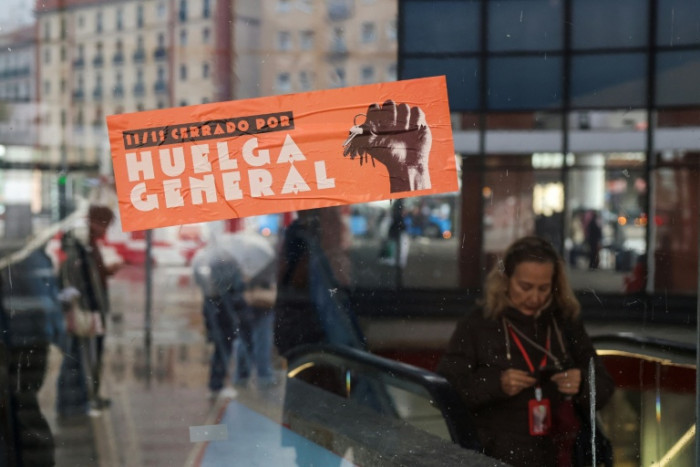
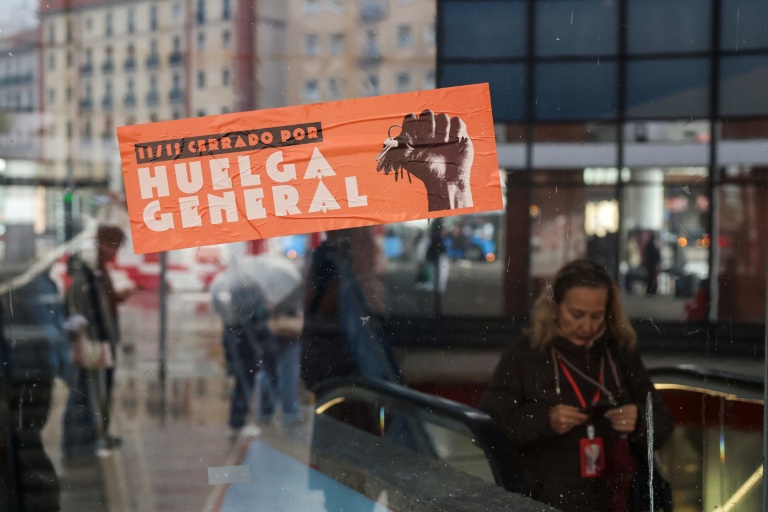
MADRID – Protesters disrupted the morning commute for hundreds of thousands of Spaniards on Wednesday as a general strike centred on the country’s chronic housing crisis began less than three weeks before the general election.
Unions reported a “massive” early uptake in Spain’s first nationwide 24-hour stoppage since 2012, which also aims to raise pressure on wages and public services, but business leaders played down the participation.
The size of demonstrations planned in Madrid and Barcelona will be seen as an indicator of public discontent before the November 29 vote, which the right-wing opposition is predicted to win.
The impact on industry and services in the European Union’s fourth-largest economy will also be scrutinised, as pickets were organised at logistics centres, industrial estates and on motorways across the country.
In Madrid, dozens of protesters braved the rain and blocked a main road leading into the centre of the Spanish capital, causing tailbacks, but many shops opened as normal.
Public transport suffered disruption even with the implementation of minimum service requirements for commuter trains, metros and buses.
In Barcelona, the metro and bus networks were out of action until the late afternoon after offering minimum services during the morning rush hour.
In contrast, Madrid’s metro reported that 93 percent of its trains ran in the early morning, although passenger numbers were down by around half.
UGT union leader Pepe Alvarez told public broadcaster RTVE that the participation was “massive”, with a “total” stoppage in some regions making the strike “a huge success”.
But UGT spokesman Rafael Espartero acknowledged participation was “uneven”, with large mobilisation in the car manufacturing, petrochemicals and meat sectors and in coastal regions, where he said housing difficulties were acute.
The CEOE organisation, which represents business leaders, said in a statement that the impact varied by region and area of work, with a “low participation” in most sectors.
Politicians ‘must listen’
The main UGT and CCOO unions called the strike following a wave of nationwide protests over access to housing, sparked by the eviction in September of an 87-year-old Madrid pensioner.
The demonstrations included a five-week occupation of Madrid’s central Puerta del Sol square, where hundreds of tents were pitched, sparking imitations in other cities.
Socialist Prime Minister Pedro Sanchez called the election, initially scheduled for 2027, after his minority government failed to secure parliamentary approval for a package of housing measures proposed in response to the protests.
Sanchez, who has governed since 2018 but trails in most polls, has urged voters to defend hard-won rights including public healthcare, the eight-hour working day and pensions amid warnings from his Socialists that the right could roll them back.
But the unions have insisted the strike is directed against all levels of the state and not only the right, which voted down the government’s housing decrees.
The Socialists and the main right-wing opposition Popular Party (PP) “must listen to us, because the streets are speaking clearly”, UGT leader Alvarez said on Wednesday.
Business groups and the right have rejected the strike, seeing an election-related gambit instead of a genuine labour dispute.
PP leader Alberto Nunez Feijoo, who leads most polls, warned that unions risked being linked to Sanchez “forever” if they went ahead with the strike.
Feijoo has also called it a “serious mistake” following a high-speed train collision last month in central Spain that killed 69 people.
Union leaders have defended the walkout as an exceptional measure intended to generate broad social pressure for action on soaring housing costs.
They are demanding a larger public housing stock, a ban on evicting vulnerable tenants as well as rent controls and restrictions on tourist accommodation in areas suffering the greatest stress.