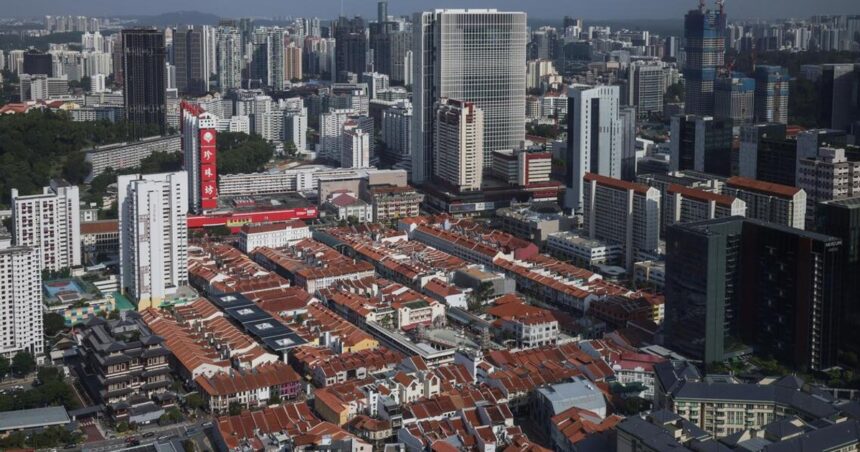
SINGAPORE – Maintaining conserved buildings could be made “more practical and less onerous for building owners” under a review of existing rules, said National Development Minister Chee Hong Tat on Nov 10.
Among other things, the authorities are studying if some “low-impact works” can be exempted from application requirements so owners can carry out routine upkeep more easily, he said.
Speaking at The URA Centre, where the 2026 Architectural Heritage Awards were presented, Chee added that a new study will be carried out to support the long-term development of Singapore’s conservation sector.
The Built Heritage Sector Consultancy Study will assess the size and profile of the sector, including architects, engineers, contractors and other specialists involved in conservation work.
“We want to identify where our strengths lie, where there are skills and capability gaps, and what may be holding back further training and development,” Chee said.
It will also make recommendations on how the sector’s capabilities can be strengthened in the long term.
“This includes looking at how we can better support training and skills development to equip our people with the know-how to ensure conservation works are done well and build stronger partnerships between government, industry, and academia,” said the minister.
The study, commissioned by the Urban Redevelopment Authority (URA) and led by consultancy Verian Group, will begin in mid-November and is slated to take 12 months.
Chee said URA will engage industry experts, professional bodies, institutes of higher learning and public agencies, and added that he hopes the recommendations will be practical and grounded in the industry’s needs.
He noted that while URA guides overall conservation efforts through broad guidelines and design strategies, Singapore needs private sector support to turn these into reality.
“As our conservation needs grow and become more complex, we must continue to strengthen the pool of professionals and craftsmen with the right skills and expertise to undertake this work,” he said.
On the review of conservation requirements, the URA said “low-impact works” which might be exempted from such requirements would generally refer to those that do not require historic fabric or structures to be removed, or add floor area to the building. Examples include adding air-conditioning units, exhaust pipes and solar panels.
“Such works are typically located at the rear or less prominent parts of the building and can be clearly guided by conservation guidelines,” said the agency, which added that works that fall outside this category will continue to require URA’s approval.
Chee also said that as part of the review, “common code-compliant solutions” for conserved shophouses and bungalows may be developed to give owners and building professionals clearer guidance on renovation and upgrading works.
On the whole, said Chee, good conservation requires “good stewardship to care for our buildings, strong partnerships to keep them relevant, and deep professional expertise to be passed on to future generations”.
“I am heartened that many building owners have come forward to work with us to conserve their buildings,” said Chee, who added that this reflects “a growing appreciation of the important role that these buildings play in preserving Singapore’s heritage”.
Citing three recently conserved buildings – Orchard Road Presbyterian Church, Starpoint bungalow and Villa Haji Kahar – Chee thanked their respective owners for their support, and said the Government will continue to work with building owners and the wider community to conserve buildings and structures that are meaningful to Singapore.
The country has conserved more than 7,200 buildings and structures since 1989.
Architectural Heritage Awards 2026 projects
-
Award for Conservation: Church of Our Lady of Lourdes, Parochial House of St Joseph’s Church (Victoria Street)
-
Award for Conservation and Innovation: 21 Carpenter Street
-
Special Mention: Blessed Sacrament Church, 163 Neil Road and Tan Kim Seng Fountain