The Greens have long been the primary progressive minor party across Australia, but as economic issues begin to dominate politics, the party may be being flanked from the left in a way it hasn’t been before.
Following successive state and federal campaigns, the Victorian Socialists (VicSoc) are running their biggest campaign yet, fielding candidates in all 88 seats in the lower house.
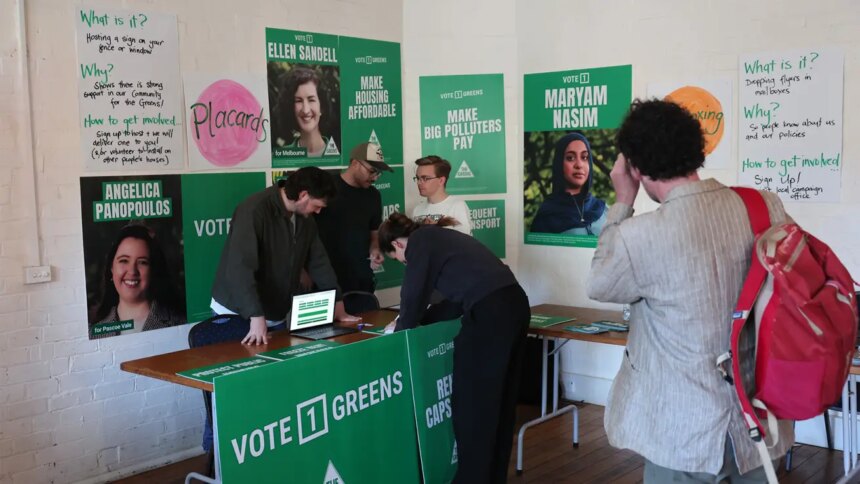
Both the Greens and VicSoc are running on similar platforms: making public transport free and more accessible, bringing down the cost of groceries, increasing housing stock and capping — or even reducing — rent. The Greens are also fielding 88 candidates.
The Greens have held Brunswick since Tim Read won it from Labor for the first time in 2018. Read was preselected to contest the seat again last year, but recently died following a public battle with metastatic melanoma.
Pulford, who is also a Greens councillor for Merri-bek city, admits he has big shoes to fill. Read won Brunswick by 13.5% in 2022, but a recent YouGov poll suggests Pulford would receive 50.8% of the two-party preferred vote, with Labor candidate Gabe Steger on 49.2%.
Related Article Block Placeholder
Article ID: 1269269

“There’s always been [a range of left-leaning parties like] Reason or Sex Party or Animal Justice Party or Legalise Cannabis,” Greens candidate for Brunswick Adam Pulford tells Crikey, “but [VicSoc’s campaign] does feel bigger than in previous years.”
However, politics has changed in the past four years, and VicSoc are hoping to make headway in seats like Brunswick this time around. (The party secured just over 8% of the vote in their first run at the seat in 2022.)
The last election took place when what is sometimes derisively called “woke” politics was stronger than it is now — a time of social reckoning and debate on issues like race, gender and sexuality, also synonymous with swift retribution or “cancellation” of anyone who stepped outside a strictly enforced code of behaviours and language.
Four years on, many voters have grown tired of the heated discourse of that brand of identity politics, and have begun associating some of the movement’s goals with establishment institutions like universities. The approach has been blamed in part for progressive parties across the Anglosphere failing to connect with working-class voters.
Democratic congresswoman Alexandria Ocasio-Cortez made headlines recently by quoting a colleague saying “Woke 1.0 was crazy”, as a way to distance herself from the more divisive rhetoric that was seen during the early days of the pandemic.
New York mayor Zohran Mamdani has also earned great support by cutting through to working-class voters with a more purely economic message — and rebranding socialism along the way.
Others within progressive circles have gone further. Dr Vivek Chibber, author of books such as Confronting Capitalism, has said the left’s focus on identity means it is not equipped to properly tackle the core economic issues facing working-class people — namely, capitalism itself.
Studies across the UK, the US and here in Australia have shown that Gen Z (born between 1997 and 2012) are more concerned with the cost of living than climate change or typical culture-war issues.
These findings, coming amid record inflation and a housing crisis — both of which have been present throughout their entire adulthood — should not be a big surprise.
“The Greens’ politics within that become inadequate,” says Naomi Farmer, the Victorian Socialists candidate for Brunswick. “The Greens’ political approach of saying ‘we just need minor changes and we’re going to compromise or negotiate about a bunch of political issues’ has led them into a bunch of dead ends, which mean their voting base is quite disillusioned with them.”
This is not to say that most voters suddenly view the Greens as representing the typical political establishment class. But it does highlight the fact that politics continues to evolve, and that the right is not alone in expressing anti-establishment sentiment.
Pulford, obviously, disagrees with Farmer’s statement, telling Crikey the party is fighting on its boldest-ever platform in this election.
Related Article Block Placeholder
Article ID: 1268797
“I’m really proud that we’re taking this to voters,” he said.
“It’s a good thing there are more people on the progressive side of Labor and who are fighting for everybody to be able to live a good life,” he added, “We’re fighting for a lot of the same things, [but] I’m in the Greens because we’re part of a national movement, represented in parliaments all across the country, that has secured real wins for people.”
Elsewhere, as Crikey reported earlier this month, the Greens have reason to be hopeful that they could pick up an extra seven lower-house seats in November — Prahran, Preston, Pascoe Vale, Footscray, Essendon and Albert Park. That’s on top of the three they already hold: Brunswick, Melbourne and Richmond.
Ultimately, the race for Brunswick will go down to the Greens or Labor. Farmer recognises the challenges in running against both the incumbent and one of the major parties.
She tells Crikey she’s hoping to grow the party’s vote share to about 15-20% and create an “earthquake” on the left to equal the movement seen on the right.
“We want to illustrate the significant left-wing vote that exists out there,” Farmer says. “I want [to show] what we’re seeing is a polarisation, not a shift towards One Nation.”