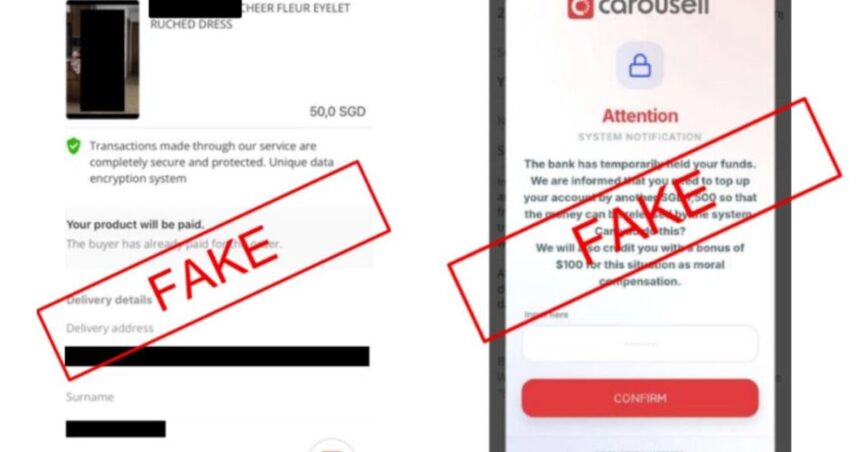
SINGAPORE – At least $180,000 has been lost since July to scammers posing as interested buyers on online marketplace Carousell.
The police said in an advisory on Oct 23 that there have been at least 63 such cases reported in that period.
In this scam, victims were typically approached by scammers posing as interested buyers through Carousell’s in-app messages or via e-mail.
The so-called buyers then persuaded them to move communications off the platform and onto messaging apps WhatsApp or Telegram.
There, the scammers sent PDF files resembling a Carousell invoice, containing a QR code and link, purportedly to facilitate payment or confirm the transaction, said the police. In some cases, an additional link using the “carousell.app.link” domain was sent, which made the phishing links appear trustworthy.
After scanning the QR code or clicking the link, victims were directed to a fake website mimicking Carousell’s official website, where a chatbot guided them through a supposed bank account verification process to receive payments.
Victims were then directed to a phishing website mimicking a bank’s website, and were prompted to provide their internet banking credentials, credit card details and one-time password, and/or approve digital token notifications.
After this, unauthorised transactions were made from their credit cards or bank accounts, including transfers to overseas cards.
In releasing the mid-year scam statistics on Aug 26, the police said $410.6 million was lost in scams in the first six months of 2026, compared with $500.2 million during the same period in 2025.

They also warned that scams remain the dominant crime type in Singapore.
For more information on scams, members of the public may also call the 24-hour ScamShield Helpline on 1799 or visit www.scamshield.gov.sg