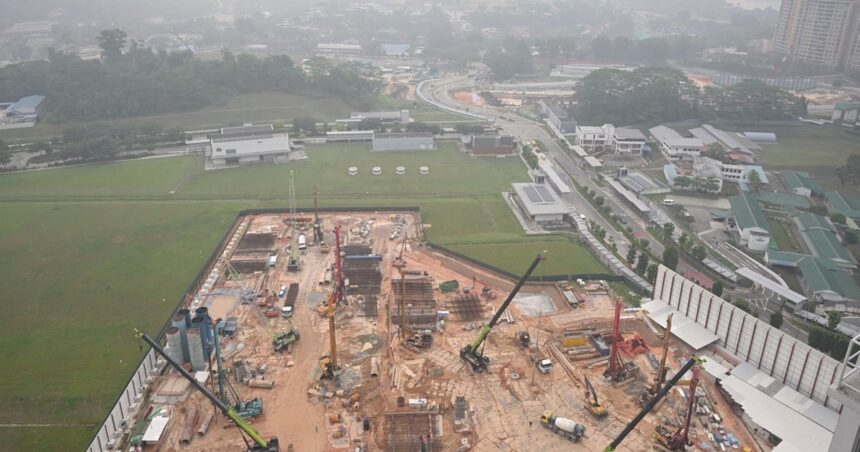
SINGAPORE – Builders are taking steps to reduce workers’ exposure to unhealthy levels of haze, even as they prepare to make claims for haze-related work delays.
Work on a number of construction projects has slowed since early September, when Singapore’s air quality first entered the Pollutant Standards Index’s (PSI) “unhealthy” range of 101 to 200, said construction lawyer Kelvin Aw.
Some builders have cut outdoor work hours, avoided crane deployment when visibility was poor, allowed more rest breaks and shifted workers to doing more indoor work to catch up with the project timetable, he added.
To help workers cope, Kajima Overseas Asia has conducted worker awareness briefings, increased the number of water coolers, installed misting fans and additional sheltered rest areas and also increased rest periods during severe haze conditions.
In addition, the contractor also identified susceptible workers with early symptoms of haze-related illness and conducted site audits to ensure subcontractors complied with all its mitigation measures.
Two ongoing public sector projects have suffered slower work progress as a result, it said.
Hi-Tek Construction corporate safety manager Raymond Lee added that it has reduced outdoor work when the 24-hour PSI is between 101 and 200.
He said supervisors also ensure that workers are hydrated and take rest breaks in sheltered areas, and check on their workers three times a day to monitor their health.
Singapore has endured almost six weeks of hazy conditions this year so far. On several days in October, the PSI entered the “very unhealthy” range of 201 to 300.
In 2023, the Building and Construction Authority (BCA) issued guidelines on how construction firms involved in public sector projects can get time extensions due to haze-related delays.
Several firms have begun giving notice in recent weeks to register these delays – the first step towards making such claims, noted Aw, who is advising clients on several construction projects, including two that are filing such notices.
BCA’s guidelines have been incorporated in a number of public sector construction contracts.
But Aw said that success rates of applications for additional time in previous years have been modest, as some builders cannot prove the delays.
BCA guidelines state that firms can seek approval for a 0.5 working day extension if the PSI is more than 200 for at least 3 hours, but less than 5 hours. Builders must also prove that haze mitigation measures affected productivity.
If the PSI is more than 200 for at least five hours, and productivity-related work delays are proven, then the recommended extension of time is one working day.
Kajima has not yet applied for a time extension for its two projects despite productivity having taken a hit, as it has not met the contract conditions under which it can do so.
“The contract for one project requires a national directive by the authorities to stop all work. For the other project, the prevailing air quality must be classified as hazardous, or PSI of more than 300 and all outdoor activities must have ceased,” said Mr Haja Kamaludeen, Kajima’s general manager (contracts).
He called on the authorities to standardise the conditions under which time extensions are claimable, and for the BCA’s guidance to be applied to all contracts.
With climate change contributing to increasingly unpredictable weather patterns, Singapore Contractors Association Limited (SCAL) said it hopes to work with government agencies to develop clearer guidance on the assessment of weather-related delays in construction projects, including the impact of severe haze and extreme heat.
SCAL president Lee Kay Chai pointed out that an extension of time does not automatically confer a right to recover additional overheads or other costs.
As such, he hopes to clarify and address wider issues faced by the industry, including the practical assessment of weather-related productivity impacts and the treatment of associated costs across different contractual arrangements.
In addition to the BCA guidance, clearer and more consistent assessment criteria would help contractors and superintending officers, which decide whether claims are awarded, to better evaluate such situations, Lee said.
This would also reduce the time and resources spent on substantiating and assessing individual claims, while ensuring that project delays are assessed fairly and consistently, he added.
Aw suggested that the 2023 BCA guidelines specify how much additional time to give but does not deal with the question of the additional costs of haze safety measures.
“A similar formula-based guidance for both time and costs would be useful,” he said.
Aw also pointed out that the current guidance applies only to public sector projects based on the government’s standard contract form, while private sector projects are not covered.
“Although the BCA has good reason not to do so, extending the guidance to private sector projects could provide parties with certainty, reduce disputes and allow builders the ability to price the risk upfront, given that the BCA guidance is already in place,” he said.
“For instance, the contract could simply state that parties agree to refer to the latest BCA guidance for assessment,” Aw added.
BCA said in response to ST’s query on its guidelines that it is “closely monitoring the impact of haze on the construction sector.”
Its spokesman said the agency it is aware of feedback on the claims process for time extensions, and “will continue to engage the industry, including SCAL, to ensure our guidelines remain relevant and responsive to evolving project site conditions.”
-
Additional reporting by Ang Qing