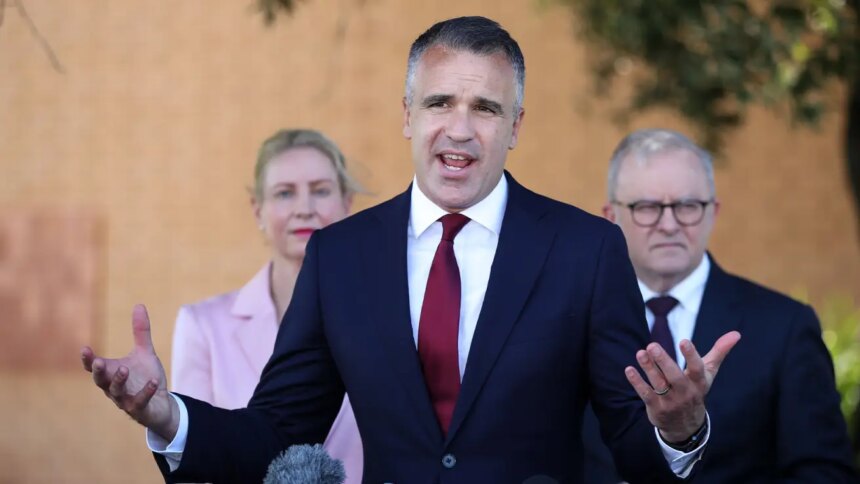
Is South Australia’s smooth-talking premier the answer to federal Labor’s woes? It’s a question that’s been batted around recently amid some old-fashioned speculation about whether Peter Malinauskas — despite his regular denials — could first become the federal member for Adelaide and then Anthony Albanese’s successor as prime minister.
This grist in this rumour mill has been partly Malinauskas’ willingness to speak out on national issues. Paul Starick, The Advertiser’s editor-at-large and designated Mali point person (and occasional dinner party host), traces the renewed Mali-for-PM speculation back to his September 9 speech to The Sydney Institute, in which he mounted an economic case for immigration and cautioned against the Albanese government’s One Nation-appeasing rhetoric.
The premier was also an early advocate for the teen social media ban after his wife read Jonathan Haidt’s buzzy book The Anxiety Generation, and is now delving into the implications of AI with SA’s royal commission into the “unprecedented” and “scary” technology. Last week, he named three commissioners, including Kate Pounder, whose eyebrow-raising roles as OpenAI’s local policy liaison and business partner with Canberra’s “minister for OpenAI” Andrew Charlton did not warrant a mention in Starick’s reporting.
But despite this flurry of speculation, it’s unlikely Malinauskas will give up his “big fish” status in SA’s small but winsome pond anytime soon, with Canberra a disappointing hunting ground for the state’s high-flyers. Malinauskas also continues to dominate local politics, generously assisted by the SA Liberal Party’s determination to strand itself in the political wilderness by electing Senator Alex Antic as their state president, the hard-right Pentecostal who — unlike his hapless Reformer colleagues in NSW — can at least accurately calculate and recruit the requisite number of god-bothering fellow-travellers needed to take over a diminished major party.
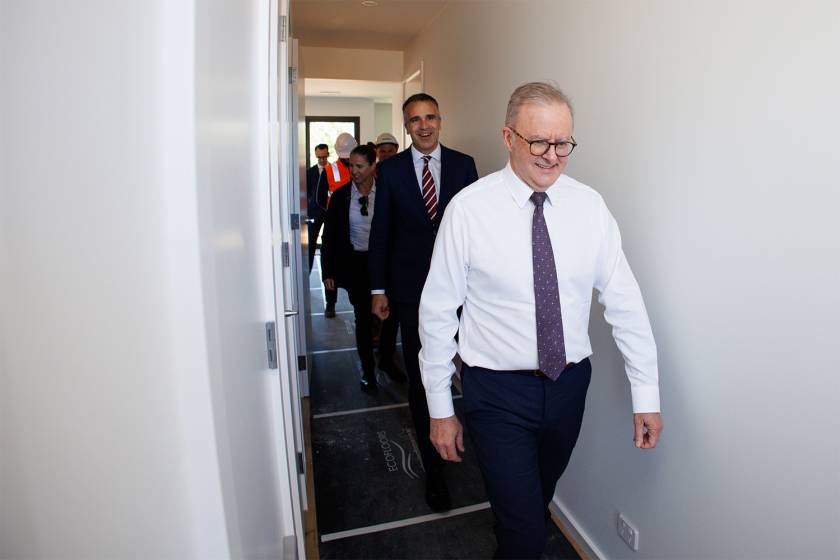
Further diminishing this fantasy is the fact that the “Teflon Pete” moniker rings far less true these days, with Malinauskas’ patronising dismissal of critics and poor choice of friends returning to the headlines. Indeed, Paul Barry’s forensic excoriation of snake oil steel tycoon and former Mali bud Sanjeev Gupta, The Big Steal, has arrived at an awkward time for the SA government, with more than 500 jobs lost at Whyalla steelworks due to the permanent closure of its aged blast furnace (which Gupta had regularly promised to replace).
Gupta and his GFG Alliance were seen as “saviours” of SA’s crumbling industrial facility from 2017 to 2024 — there were literal parades through Whyalla’s streets — having accumulated an array of creaky steel plants alongside his collection of luxury homes and flashy media events. Australia’s media and politicians were happy to overlook his consistent failure to act on grandiose commitments, even as his oft-promised investment never materialised, and as the global Ponzi schemes of his steel magnate partner-in-crime, Lex Greensill, attracted attention from UK and German regulators and media heavyweights such as the Financial and Sunday Times.
Malinauskas and his then-energy and mining minister, Tom Koutsantonis, finally grew suspicious when Gupta’s funds failed to arrive after the fourth ribbon-cutting exercise, and implemented an audacious cloak-and-dagger plan in February 2025 to force the steelworks into administration. Labor hastily announced a $2.4 billion rescue plan, which came as no surprise: see last week’s $200 million bailout of Rio Tinto’s Bell Bay aluminium smelter, the $2.5 billion and $2 billion bailouts of the Tomago aluminium and Boyne smelters respectively, the $600 million bailout of Glencore’s Mt Isa copper smelter, and the $135 million bailout of Nyrstar’s Port Pirie and Hobart smelters.
In the wake of this disaster, Malinauskas has chased further controversy, having promptly ditched Gupta for a new best friend: then-CEO of the sportswashing LIV golf tournament Greg Norman. In July, the premier awarded the retired professional golfer a no-tender contract to design the course central to the $45 million upgrading of the North Adelaide Golf Course. It will involve the clear-felling of 585 parkland trees required to host a golf tournament that is currently under legal siege and whose demise seems inevitable.
Malinauskas is also busy cosying up to MotoGP, waving through yet further desecration of Adelaide’s famed parklands to deliver a street circuit in the city centre for the motorbike race he snatched from Victoria’s Phillip Island — the first race on city streets since 1982, after they were deemed too dangerous given their propensity to kill riders. In advance of a freedom of information request from Rex Patrick, the track’s plans were released in August with a $96 million price tag, revealing that even more parkland trees than expected were due for the chop.
Malinauskas has clearly calculated there are more rev-heads in Adelaide than conservationists, with his government happily condemning those protesting the parkland felling as a “ragtag group of extremists“. But the premier has faced opposition in the courts, too: one case, ultimately unsuccessful, opposed golf course development based on the parklands’ national heritage listing, while another has sought an urgent injunction against works associated with the MotoGP, similarly arguing that works are in breach of federal conservation laws.
Related Article Block Placeholder
Article ID: 1249747
These lawsuits take place against the backdrop of disquiet within the legal community, with the appointment of former Labor minister Andrea Michaels to the role of associate justice of the Supreme Court raising eyebrows. It came on the heels of her unexpected decision not to seek reelection for the seat of Enfield at the 2026 state election, a move that conveniently cleared the way for Don “the Godfather” Farrell’s son-in-law to be preselected for the plum seat less than 24 hours later.
As Malinauskas himself is all too aware, the patronage of the evergreen Farrell — who, aged 72, recently announced he would seek a further term in the Senate — yields significant professional benefits, as, apparently, does knowing when to get out of his (or his family’s) way. Malinauskas has always been a loyal foot soldier for Don and the Shoppies, and proved it again in June when he stunned his fellow Caucus members — particularly the female ones — with his support of an outlier Family First bill to restrict access to abortion.
As the sheen comes off the smooth-talking premier, he’s moved to insulate his position by delegating oversight of the MotoGP to Blair Boyer, an inexplicable additional responsibility for a busy health minister — unless one is abreast of Labor rumours that Boyer is currently the MP most likely to challenge Malinauskas for the premiership in the future.
Any such challenge seems a long way off. By that time, Mali’s kids will have likely left school, and perhaps he’ll be turning his gaze to Canberra after all. If so, he’d do well to remember that not since Joe Lyons has a premier successfully upgraded to prime minister, and Lyons ratted on Labor to do so.
Can’t see the Godfather copping that.