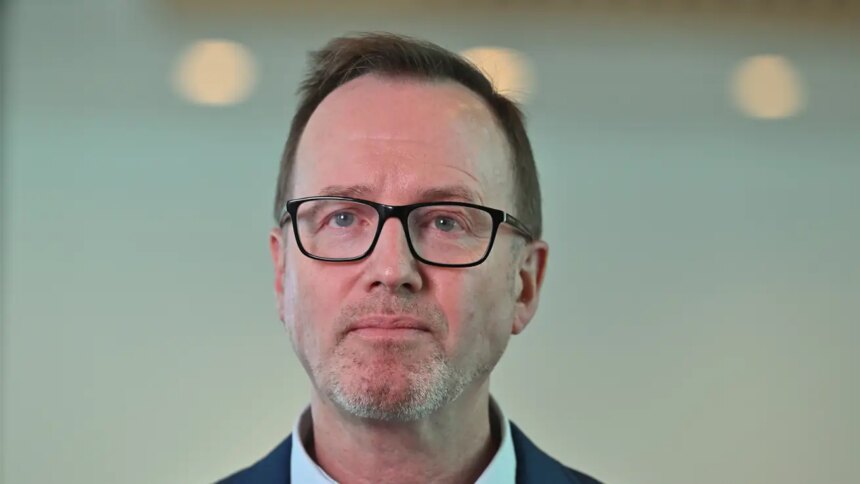
Green smoke has risen from the Greens federal partyroom: NSW senator and key AUKUS critic David Shoebridge has been elected the party’s new leader, with Victorian millennial Steph Hodgins-May to serve as his deputy.
Speaking alongside outgoing leader Larissa Waters, Shoebridge called on Australians to join the Greens in fighting against vested interests, slamming Labor’s gradual change as “dead politics”. “We’re going to cross the country,” he promised. “We’re going to deliver that sense of hope and opportunity that Australians are begging for, and we are also going to meet the climate crisis.” The AFR has already labelled him a “trot”.
Given the crowded leadership field and accompanying questions the vote had raised about the direction of the party, it took surprisingly little time for the Greens parliamentarians to reach a consensus. Will this mean an equally swift change in direction for a party that has been struggling to cut through?
The Greens can’t seem to catch a break, but did finally score some headlines this week, though unfortunately only as a result of them losing and gaining another leader, following Larissa Waters’ shock announcement that she was standing down due to worsening kidney disease.
Related Article Block Placeholder
Article ID: 1266511
Waters’ 16 months in the job have been solid but quiet, as the party grappled with what to make of their disappointing 2025 result, which — though they were left with similar numbers in the Senate — cost them their last leader, Adam Bandt, as well as young firebrand Max Chandler-Mather.
I wouldn’t suggest, as the ABC’s Politics Now does, that the Greens are “languish[ing] in the polls”, but it’s clear the party needs a fresh burst of energy. The Greens still aren’t picking up support despite a surging anti-establishment vote, most of which is being hoovered up by One Nation on the far-right. The Victorian Socialists, meanwhile, look hungry and energised, eager to capitalise on a global wave.
Today’s field included longest-serving Greens senator Sarah Hanson-Young, representing the party’s more “pragmatic” wing, and running solo; current deputy Mehreen Faruqi, with Tasmanian Nick McKim as her deputy, from its more radical left flank; and then Shoebridge and relative newbie Hodgins-May, whose social media has been notably strong. Shoebridge and Hodgins-May, both former lawyers, may very well have pulled off a Morrison-esque slide through the middle of two more polarising options, with both Hanson-Young and Faruqi having put their hands up before.
What do you think of the Greens’ new leadership?
Let us know in the comments below, or write to us at letters@crikey.com.au to be published in Crikey. Please include your full name. We reserve the right to edit for length and clarity.
This represented five out of 11 members of the partyroom — almost half, for those playing along at home. Those not running included Penny Allman-Payne, Jordon Steele-John, Elizabeth Watson-Brown, Barbara Pocock (retiring at the next election), Vanessa Bleyer (filled a vacancy just five months ago) and, of course, Waters.
Chandler-Mather had called for a member vote, arguing it would “recreate the political success and energy of UK Greens leader, Zack Polanski, or New York mayor, Zohran Mamdani” — part of building the mass movement the energetic millennial has in mind. Former leaders Bandt and Bob Brown, meanwhile, said the new leader had to be able to take the fight up to One Nation and Labor, blocking fossil fuel projects while extracting serious reforms.
Brown had suggested that the overly crowded field represented a “depth of talent”, adding that he was “very confident” any of the prospective candidates could do it. On the contrary, the fact there were so many candidates for the leadership indicated to me that the Greens currently lack a stand-out, obvious figure around whom to rally. The Greens need a Polanski or a Mamdani, a charismatic unifier who can speak compellingly to those looking for alternatives. What they have is a roster of names who have become rather tired and are struggling to make their mark.
Related Article Block Placeholder
Article ID: 1266850

Can Shoebridge and Hodgins-May cut through? Both are relative newcomers to the federal party, though Shoebridge was a long-time fixture of NSW politics, where he served from 2010 until 2022. Of all of today’s options, they are the clearest communicators — a necessary skill in a media environment that is never going to be kind to the Greens. In their announcement, the pair said they sought not to “reform” Labor but to “replace them”, a line in keeping with those who would like to see a more bolshy Greens.
It’s worth noting that the Greens will have new senators in South Australia, Victoria and Western Australia come the next election, assuming they win spots in each of those states (two of those spots are currently held by Dorinda Cox and Lidia Thorpe, whose terms are up in 2028). But the party can’t wait that long, with One Nation’s polling numbers showing alarming resilience and Labor and the Coalition increasingly pandering to them.
Chandler-Mather’s proposal obviously didn’t get up this time, with Waters clearly needing to step back immediately for her health. Shoebridge and Hodgins-May could very well be what the party needs. But it may also be time to look to the leaders to follow, elected via popular vote.
The best thing the next Greens leaders could do is open the floor to fresh talent, so that the party might sooner find the voice it is looking for. That Polanski-Mamdani must be out there somewhere. But for now Shoebridge-Hodgins-May will have to do, as the Greens try to restart the fire that seems to have banked in recent years. And where there’s smoke…