Most of seized cannabis from Thailand and North America
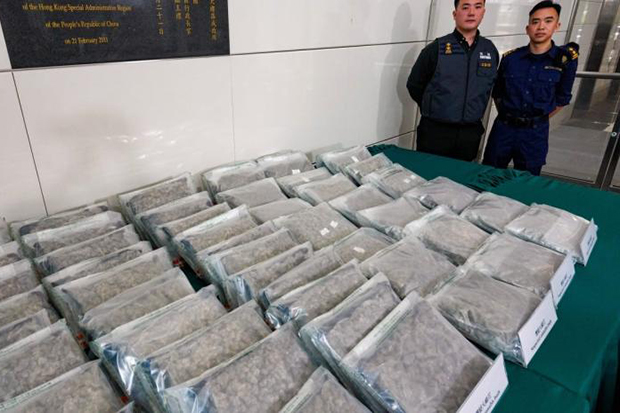
Hong Kong customs recorded a nearly 50% year-on-year rise in drug seizures during the first half of 2026, driven by notable increases in smuggling activities via air and sea routes.
The Customs and Excise Department confiscated 5,704 kilogrammes of illegal narcotics in the first half, a 49% increase year on year, according to figures seen by the South China Morning Post.
Nearly two-thirds of the seized narcotics, or 3,408kg, were found at the airport, a 46.6% year-on-year increase at that port of entry. Those on sea routes accounted for one-third, or 1,954kg, representing a 55.6% rise. The remaining 342kg were confiscated at land checkpoints and other parts of the city.
Cannabis and ketamine accounted for about 60% of the drugs seized in the first six months, marking a rise of 40% and 78.8% of those substances, respectively. The number of drug cases detected by customs and the number of arrestees also recorded a slight increase.
“Sea routes have always been used by smugglers to diversify risk. When they ship drugs by sea, the volume per shipment is usually larger. So whenever a confiscation happens, a single case can end up involving a larger quantity [of drugs],” he said.
Last week, customs made the city’s largest-ever sea shipment drug seizure, uncovering HK$125 million (533 million baht) worth of marijuana in a 40-foot container and arresting three people.
According to the officer, syndicates mainly concealed drugs in different goods, such as by mixing them among buckets of sugar cubes or hiding them in hollowed-out timber and pool tables. In some cases, they recruited crew members of ocean liners to carry drugs for them.
But air travel remained the largest contributor to the overall rise in drug seizures, with 95 cases committed by air passengers in the first half of this year representing a 35.7% year-on-year increase.
He said trafficking by air also led to the amount of drugs seized at land ports increasing almost fivefold because some courier companies moved their distribution centres to Shenzhen and Guangzhou, with some air cargo logged as ground interceptions when they moved through Hong Kong’s land checkpoints.
The officer said customs expected that drug smugglers would change their methods of moving contraband in the second half of the year in response to authorities’ enforcement efforts.
Many air passengers recruited to carry drugs who were caught at the start of the year, for instance, had flown directly from Thailand. Afterwards, they changed their routes slightly by flying via a transit airport to prevent being targeted by customs.
“We found that if they discovered we had stepped up enforcement in certain channels, they would change their modes of smuggling … We will monitor closely [to see] if the trends change,” he said.
The officer said the surge in cannabis seizures was mainly due to the legalisation of the drug in certain countries and an increase in the number of users globally. Most of the cannabis seized this year came from Thailand and North America.
On ketamine, the officer said the synthetic drug was relatively easy to detect during the production stage in Hong Kong, and most of it seized by customs came from Europe, where there was more space to manufacture it. Incoming ketamine could be supplied locally or transited elsewhere.
He added that customs would help the logistics industry identify suspicious clients, such as those who placed urgent orders, made last-minute changes to delivery instructions or failed to provide direct contact information.
A customs spokesman said the department had adopted an intelligence-led strategy while working closely with local, mainland and overseas law enforcement agencies to execute joint operations, identify drugs at their source and block illicit narcotics from entering Hong Kong.
He said strict control measures were enforced across all sea, land and air control points, with risk assessment frameworks and advanced technology, such as specialised X-ray systems and ion mobility spectrometers, used to enhance detection capabilities.