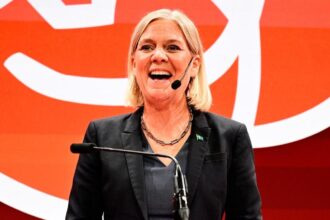
Farmers worried about recruiting enough backpackers to pick their fruit and harvest other crops under an immigration crackdown should hire unskilled and semi-skilled labourers from the Pacific islands and Timor-Leste, an Albanese Government minister said today.
Employment Minister Amanda Rishworth said she did not accept warnings from agricultural groups that the changes announced yesterday could trigger a labour shortage in country areas and drive up food prices.
She said farmers worried about losing access to working holidaymakers — typically European backpackers who will have to enter a lottery to extend their stays — should apply for a little-known federal program known as PALM, for the Pacific Australia Labour Mobility scheme.
“I don’t accept the premise of what’s being put forward,” Ms Rishworth told the ABC. “We have taken a responsible approach to migration; a sustainable approach to migration.
“Backpackers in their second and third year will have to work in regional areas. There is also a number of other places that people can get agricultural workers, and I’d point to the PALM scheme.”
She was unable to say whether the government has undertaken modelling to determine what the effect would be on wages.
Nationals MP Michael McCormack said the agriculture sector was “desperately worried” by Labor’s cuts which could “cripple” regional Australia. “There will be fruit that’s just left to rot on the vine, on the trees, and falling to the ground,” he told News24.
The Coalition wants to reduce net overseas migration more than the government.
The suggestion farmers hire short-term workers from nine Pacific island countries and Timor-Leste appeared to be at odds with the government’s intention to cut the large number of temporary migrants, also known as guest workers.
Mr Burke told the Nine newspapers this week he was “very worried about” the number of temporary migrants, who have exceeded 3 million, or 16 per cent of the workforce.
Despite promising to prioritise agriculture and fisheries for skilled-worker visas, the government is coming under huge pressure from the farming lobby over Thursday’s changes.
National Farmers’ Federation President Hamish McIntyre said farmers were furious the government had slowed processing of Working Holiday Maker visas from a few days to three months.
“This is a low blow for farmers and the businesses that produce Australia’s food and fibre,” he said.
“Working Holiday Makers fill about one in seven farm jobs making them central to getting food and fibre produced, harvested, packed and into supermarkets.”
The PALM scheme requires employers to cover the travel costs of workers from Fiji, Papua New Guinea, Solomon Islands, Vanuatu, Samoa, Tonga, Tuvalu, Kiribati, Nauru and Timor-Leste. The workers, who can stay for nine months or four years, depending on the type of visa, pay back their relocation costs out of their wages.
After a promising start, interest in the scheme has stalled. There were 32,365 workers using the visas last November, about 2000 fewer than a year earlier, according to Stephen Howes, a professor at the Australian National University.
The high cost of the visas made them impractical for farms with short harvests, including wheat and other grains, NSW Farmers’ Federation president Rebecca Reardon told The Nightly.
“It takes a very long time to access the program, whereas working-holidaymakers we can typically get them in a quick timeframe,” she said.
“We’ve already got farms that are six weeks away from the harvest. With he slowdown we’re seeing in processing, those workers they had lined up to come to and harvest are not going to be available.”
Reaction
Speaking on ABC’s 7.30 on Thursday night, Mr Burke said Australia needed a migration system that eases housing pressure, delivers workers where they’re needed, clamps down on visa abuse and overstayers, and keeps refugee numbers unchanged.
He rejected claims that the Prime Minister watered down his plan after his initial press club address was cancelled and claimed his measures had existed in similar form since February.
Mr Burke acknowledged the concerns about the agricultural workforce but argued the PALM scheme was underused and could meet labour shortages.
“They’re right to be concerned about agricultural workforce. And as I said before, there is no part of the economy where you can have an impact on immigration without having some tension there,” he said.
“But I’d say this for the agriculture sector, the government has a Pacific worker program called the PALM Visa. It’s really important to us as a government, and it’s been really effective in our relationship with the Pacific. That area is still underutilised.”
Mr Burke rejected comparisons to US-style ICE enforcement.
Deputy Opposition Leader Jane Hume accused Labor of trying to “have it both ways” with its proposed changes to further reduce migration in a fiery exchange with Health Minister Mark Butler on Sunrise.
“You can’t have it both ways,” Senator Hume said. “Yesterday, Tony Burke said that any lower number would crush the economy. But he also said in the same breath that he needed the legislative powers in order to make it lower, and that the Coalition wasn’t willing to help.”
Mr Butler said Labor’s plan would strike a balance between reducing migration and meeting critical workforce shortages.
“Our advice is the plan that Tony (Burke) laid out yesterday will get us to the numbers we set out in the budget, which we think are the right balance,” the Labor frontbencher said.
Shadow resources minister Susan McDonald warned regional employers could struggle to keep businesses running and get crops to market under Labor’s new working holiday visa arrangements.
She claimed the Albanese government “completely bungled immigration from day one”.
“They created this mess and true to form, their solution makes no sense and will create more problems,” she said.
Shadow Home Affairs Minister Jonno Duniam said the Coalition was scheduled to release their immigration policy before parliament returns for its October sitting.
“I expect we’ll have our policy out before we return to Parliament in three weeks’ time. We’re in the final stages of pulling the details together,” the Liberal Senator said.
“We’re going to get it right. We will be fully modeled, fully costed, and we’ll be able to defend a policy that actually makes sense and is good for our country.
“Unlike One Nation who’ve had four policies in four weeks and still can’t give us the details, no one’s been out to explain it.”